Posts

Methane to acetic acid conversion

Image
Methane to acetic acid conversion step 1: Methane to methyl chloride methane is treated with cl2/hy and we get methyl chloride step 2: methyl chloride to methyl cyanide methyl chloride is treated with KCN and we get methyl cyanide Step 3: Methyl cyanide to acetic acid Hydrolysis of methyl cyanide will give acetic acid.

Ethane to acetic acid conversion

Image
Ethane to acetic acid conversion  Step 1: Ethane to Ethyl chloride Ethane is treated with cl2/hy and we get ethyl chloride Step 2: Ethyl chloride to ethanol Ethyl chloride is treated with aq. KOH and we get ethanol Step 3: Ethanol to acetic acid Ethanol is oxidised by strong oxidising reagent K2Cr2O7/Conc. H2SO4 and we get acetic acid 

definition of buffer solution and buffer capacity type of buffer solution and its example

the solutions in which the addition of small amount of acid or base not change the pH such kind of solution are called buffer solution . hence buffers are the solution with reversed acidity and alkaline alkylinity . buffer solution usually consist of  1 .weak acid and its salt : acetic acid + sodium acetate  2. alkaline mixture of weak base and its salt : ammonium hydroxide and ammonium chloride 3. weak acid and weak base: ammonium acetate buffer capacity  buffer action is defined as the resistance to change in the h+ ion concentration on the addition of acid or alkali . the magnitude of the buffer action of a buffer is determined by its buffer capacity it may be defined in terms of addition of both acid and alkali.  usually it is measured by the amount of strong base required to produce unit change of the PH in the solution.

define indicator and classification of indicator

indicators are weak organic acids or bases that are used to detect the equivalence point for the titration of an acid by a base . indicator is a substance that changes the colour at the equivalent point . the colour change takes place when a certain PH value is reached in the case of acid base indicators.  depending on the type of titration indicators may be classified into three classes  1. acid base or neutralization indicators  are used for acid base titration for example methyl orange indicators  2.redox indicators this are used for redox titration for example diphenylamine  3. adsorption indicators  this are used for precipitation titration for example rodhomin

mannich reaction and example

Image
the compound which is capable to form enol mostly ketone and aldehyde when react with a mixture of formaldehyde or formalin who is 40% aqueous solution of formaldehyde and secondary Amine in the presence of acid or Lewis acid gives amino methyl derivative is called Mannich reaction. Example: 1.amino methyl derivative or mannich base with ag2O gives alkene. 2.  amino methyl derivative or mannich base with NaoEt gives alkene. 3. amino methyl derivative or mannich base with NaCN gives cyanide then with stefan reagent gives aldehyde.

calculate the pH of 0.001M H2So4 .given k2 =1.01×10^-2

Image
Chemistrynext

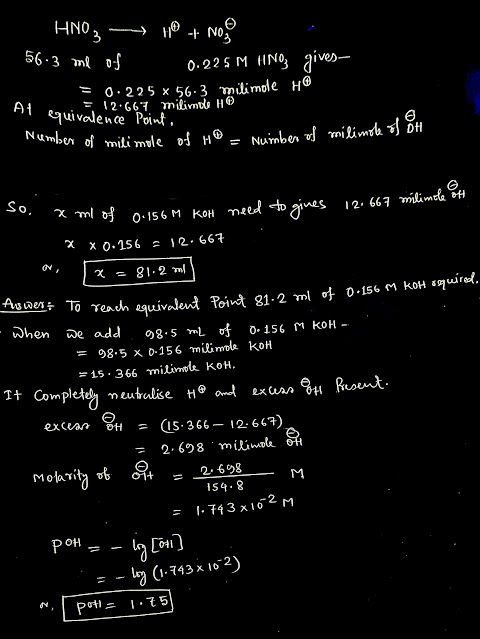
A 56.3-mL sample of 0.225 M HNO3 is titrated with 0.156 M KOH. a. Calculate the volume of base required (in mL) to reach the equivalence point. b. Calculate the pH after adding 98.5 mL of KOH

Image
Chemistrynext

Solubility of AgCl is 10^-5 mole/liter.calculate the solubility in water and in 0.01MNaCl

Image
AgCl is a sparingly soluble salt and in water small percentage of its dissociates . For calculate solubility we use solubility product formula. solubility product of a salt Ksp=multiplication of activities of ions Activity=Concentration ×activity coefficient.